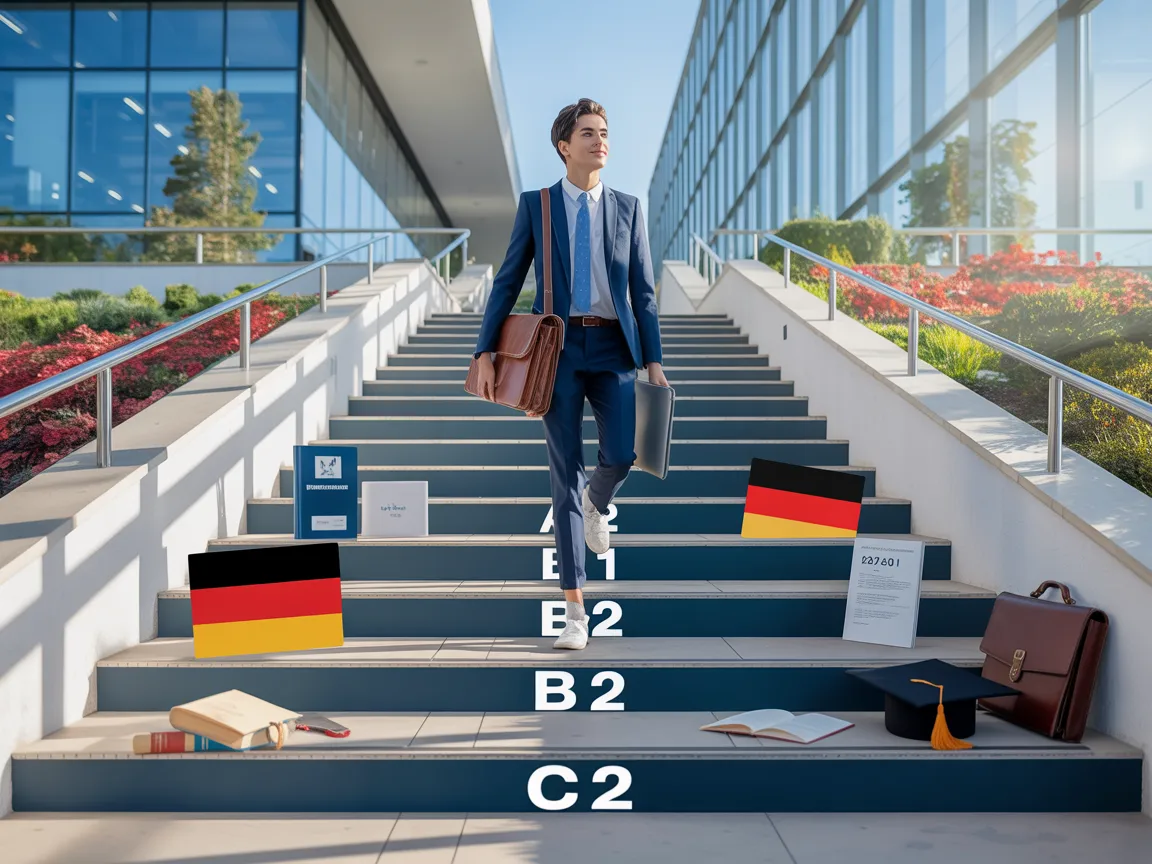
Study German Daily: You are learning German. Whether you learn German for PR for your studies for a nursing job or, for career growth you have probably asked yourself:
I am trying to learn the language. How hours should I study the language each day to become fluent?
👉 “Is 1 hour enough?”
👉 I am trying to reach B2. “Do I need to spend 4–5 hours to reach B2?”
At The Language Spectrum (TLS) we have trained thousands of learners from A1 to B2. The Language Spectrum (TLS) has observed one thing:
💡 I know that studying hours is not the goal. I know that studying the way is the goal.
I wrote the guide to tell you how hours you need each day. The guide bases the hours on your goal, your level and your learning speed.
Why Daily German Study Matters
German follows the principle:
Small, consistent study > Long, inconsistent study
Here’s why daily study matters:
I have found that German needs habit building. Habit building helps keep the grammar and the vocabulary retention.
I have seen that the spoken confidence improves when you expose yourself to speaking every day. The spoken confidence grows with exposure.
I have noticed that your brain needs repetition cycles. The brain uses repetition cycles to store rules, for the term.
I notice that 30 minutes a day keeps progress from resetting. 30 Minutes a day protects the work already done. 30 Minutes a day is all that is needed.
Daily study helps the learning process become smarter. Daily study does not make the learning process harder.
Read More: German vs English: 10 Differences Every New Learner Should Know
How hours, per day should I study German?
TLS experts recommend that study durations differ for each level. In my experience TLS experts advise using a study duration, for each level.
📘 A1 Level — Recommended Daily Study: 45 to 60 Minutes
At A1 you are building your foundation:
Basic grammar (articles, verbs, sentence structure)
Essential vocabulary
Small conversations
Why 1 hour is perfect:
Keeps the language fun and not overwhelming
I notice the program helps new learners stay consistent. The program keeps learners on track.
Gives enough time to revise + learn new words
A1 Tip from TLS:
Spend 20 minutes of that hour ONLY on speaking (even to yourself!).
📗 A2 Level — Recommended Daily Study: 1 to 1.5 Hours
A2 introduces:
Past tense
More complex sentence structures
Describing experiences & daily life
You need a little time. Here is why:
I see the grammar rules increase. The grammar rules become more in number.
The sentence-building process becomes more important. Sentence-building matters now because sentence-building helps everyone understand the point. The more we practice sentence-building the clearer our writing becomes.
I think listening practice is essential. Listening practice helps the ear hear better. The mind stay alert.
A2 Tip:
Practice ten verbs each day → practice makes the B1 transition smoother.
📙 B1 Level — Recommended Daily Study: 1.5 to 2 Hours
I think B1 is the turning point, in learning. B1 changes everything.
You need to:
Write long texts
Understand longer audios
Speak confidently on everyday topics
Why two hours works best:
I see the grammar becomes more advanced. The grammar has rules that help us write better.
I practice listening and speaking daily. I notice that listening and speaking every day makes me better.
Exam preparation begins here
B1 Tip:
Do 30 minutes of listening every day — Deutsche Welle, easy German podcasts, or TLS practice audios.
📕 B2 Level — Recommended Daily Study: 2 to 3 Hours
The level required for:
Nursing jobs
IT and professional roles
University admissions
PR application advantage
B2 demands:
High vocabulary
Strong grammar control
Fluency in long conversations
Writing advanced texts
Why 2–3 hours is ideal:
You are preparing for job-life communication. Job-life communication will help you connect work and life.
You must understand the German spoken at a speed. You need to hear the German fast.
I notice that reading and writing become exam-focused. Reading and writing now turn into a test focus. The reading and the writing only serve the exam now.
B2 Tip:
Alternate days between:
✔ Practice that uses a lot of grammar
✔ Listening & speaking-heavy practice
I notice the system keeps the learning balanced.
⏳ TLS Expert Formula: The 3–Zone German Study Structure (Works for All Levels!)
Instead of randomly studying, follow this proven plan:
1️⃣ Input Zone (20–40 mins)
→ Learn something new
Examples:
Grammar rules
Vocabulary sets
New audio lessons
2️⃣ Practice Zone (20–40 mins)
→ Apply the things you learned. The things you learned will help you.
Examples:
Sentence-building
Writing small paragraphs
Speaking exercises
3️⃣ Immersion Zone (10–20 mins)
→ Experience German naturally
Examples:
Short videos
German reels
Audio practice
Flashcards
🎯 This structure ensures:
✔ Balanced learning
✔ Long-term memory
✔ Faster progress
📅 A realistic daily study timetable (TLS recommended)
Choose based on your schedule:
⏱ 1-Hour Timetable (Beginners A1–A2)
20 min – Grammar
20 min – Vocabulary + Speaking
20 min – Listening
⏱ 2-Hour Timetable (B1 Learners)
45 min – Grammar + Writing
30 min – Listening
30 min – Speaking
15 min – Vocabulary revision
⏱ 3-Hour Timetable (Serious B2 Learners)
1 hour – Grammar + Advanced structures
45 min – Listening (native speed)
45 min – Speaking practice
30 min – Reading or writing
🏆 TLS Special Insight: I think the Indians need a Structured Routine
Most Indian learners have trouble because of the following:
Memorizing instead of understanding
Skipping speaking practice
Comparing German to English rules
Long study gaps
I notice that when they follow the TLS structured routine:
📈 I notice that the A1–A2 completion becomes easier for me. The A1–A2 completion now takes time and effort.
📈 I notice that B1 confidence increases. B1 confidence is going up.
📈 I notice that B2 becomes possible in the time we have. We can do B2 in the time we have. B2 is, within reach.
I often wonder how hours I should study each day. It helps me plan.
I will decide based on the goal you have:
Goal Recommended Hours
Slow learner / Working professional 45–60 mins
Steady learner 1–2 hours
Fast-track to B2 (Job/PR) 2–3 hours
Exam in <4 months 2+ hours
Casual learner 30–45 mins
Final Advice from TLS Experts
If you want the progress remember the progress: I have seen the real progress work.
✔ I notice that the consistency beats the intensity. The consistency wins because the consistency stays. The intensity cannot keep up with the consistency over time.
✔ Daily exposure > once-a-week heavy study
✔ Speaking beats memorizing. Speaking is more important, than memorizing.
✔ Quality materials and expert guidance make all the difference
At TLS, we help you follow a personalized study plan based on your speed, goals, and level.
Read More: How to Become a Nurse in Germany: Your Essential Guide