German vs English: If you are starting the learning journey one question comes up often: “Is German similar to English?”
Short answer: Yes… but also NO.
English and German share the language family, the family. English and German have words that feel familiar. English and German grammar rules and structure can surprise learners. In my experience Indian learners feel the surprise most.
I want you to learn German faster. I also want you to avoid the confusion. Here are the ten important differences, between German and English. I explain the differences in the way, for a learner.
1. German has three genders. English has no gender all.
In English, nouns are neutral:
the table
the girl
the car
When I look at the language I notice that each noun has a gender: German nouns always have a gender.
der Tisch (masculine)
die Frau (feminine)
das Auto (neuter)
I notice that genders do not always make sense. I learn genders with the noun.
TLS Tip:
Always memorize the nouns and the articles: der Hund, die Lampe das Brot. Knowing the nouns and the articles leads to use.
2. German writes every noun, with a capital letter. German applies the rule to all nouns.
English does not capitalize everything. I see that English only capitalizes the nouns (India, Delhi, German).
German capitalizes each noun. German always puts a capital letter at the start of each noun.
Ich lerne Deutsch.
Das Buch ist neu.
Die Lehrerin ist freundlich.
I have used the method. The method helps new learners identify nouns easily.
3. German Words Combine to Form Long Words
German loves compound words. The compound words are two or more words joined together.
Examples:
Handschuh (hand + shoe = glove)
Kühlschrank (cool + cupboard = refrigerator)
Geschwindigkeitsbegrenzung (speed limit)
The long words can look scary. I have seen the long words break into words. The long words are words glued together.
4. Verb at the End — One of the BIGGEST Differences
The input, from the user follows:
English follows:
Subject + Verb + Object
➡ I am learning German. I study the language for an hour each day.
German often puts the verb at the end. German does this in clauses.
➡ Ich lerne Deutsch, weil ich nach Deutschland gehen möchte.
(I want to go to Germany. That is why.)
I notice that practice takes effort at first. I notice that practice becomes natural as the time passes. I notice that practice feels rewarding when practice becomes natural.
Read More: 10 Common Mistakes Indians Make While Learning German (and How to Avoid Them)
5. German Pronunciation Matches the Spelling (mostly!)
English pronunciation is unpredictable:
tough
though
through
German is consistent and phonetic:
The letter A always sounds like ah. When you say the A you hear the ah sound each time.
I hear that the letter E always sounds like eh.
The letter I sounds like ee. The letter I makes the sound ee.
“V” sounds like f
I hear the W, as the v.
I think the pattern makes German easier to pronounce. You just need to learn the pattern.
6. German has a you. German also has a you (Sie, versus du).
When I talk in English I use you for everyone. The elders, the friends, the strangers.
In German:
du → informal (friends, family)
Sie → formal (teachers, elders, workplace)
I notice that using the form makes the wrong form sound rude or too casual. Beginners must learn the difference.
7. German Cases Change Articles & Pronouns
I notice the material is new, for learners. The material is also new, for English speaking learners.
German has four cases:
Nominative
Accusative
Dative
Genitive
Cases affect articles:
der Mann (Nominative)
den Mann (Accusative)
dem Mann (Dative)
I think the articles matter a lot, in German. The articles tell the gender and the case. Articles are the key, to meaning.
8. German Verbs Split in the Middle (Separating Verbs)
English: one-piece verbs
I wake up.
German: some verbs split
Ich stehe um 7 Uhr auf.
(aufstehen = to get up)
I see beginners often forget the ending piece. I know that mastering the ending piece makes a speaker sound fluent.
9. I see that English uses more of the helping verbs. German uses more of the endings. I notice the difference.
I think English uses helping verbs a lot:
The person is eating.
I will go
The person has finished.
German shows many of the meanings. German does that by changing verb endings:
Ich esse (I eat / I am eating)
Ich werde gehen (I will go)
Ich habe gegessen (I have eaten)
I have noticed that a verb form often carries many of the meanings. A verb form can hold meanings at once.
10. Word Order Changes Frequently — German is More Flexible
English word order is strict:
Subject + Verb + Object
German lets you change the meaning by moving the emphasis. I have noticed that German lets you shift the meaning when you stress a word in the sentence. German shows how a change, in emphasis can change the sense of the sentence.
Heute lerne ich Deutsch. (Today I am learning German.)
Ich lerne heute Deutsch. (German I am learning today.)
Ich lerne heute Deutsch. (I learn German today.)
When I understand the rules German feels logical. German follows the rules.
Final Thoughts: Is German Really Harder Than English?
I think German looks hard at first. I see that the rules, in German are consistent. I see that the rules in German are logical. I see that the rules, in German are predictable. English is different. English has exceptions.
Most Indian learners say: “I thought German was hard, at first. German got faster, than English!”
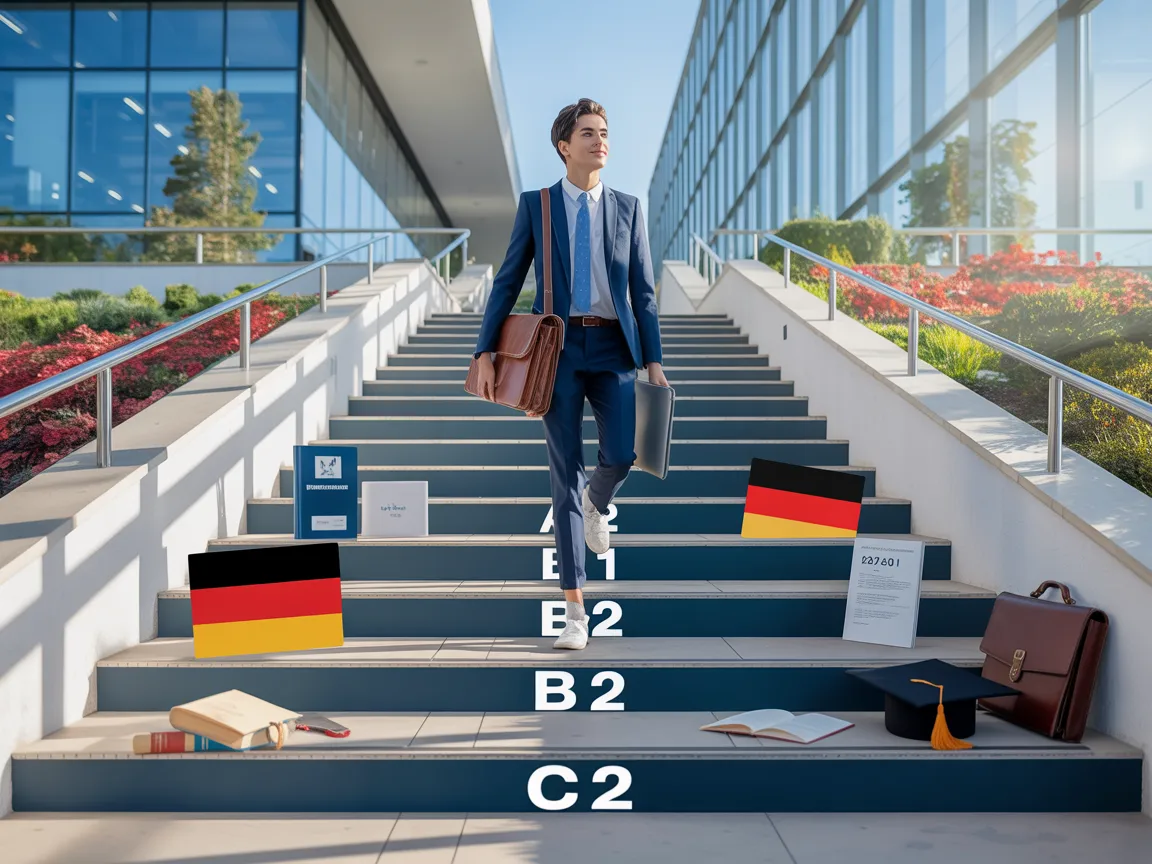
The right guidance matters. The structured learning matters. The regular practice matters. The right guidance, the learning the regular practice let you reach A2, B1 or even B2 faster than you expect. I have seen the guidance, the learning, the regular practice work.
Read More: 5 German Words Indians Always Pronounce Wrong — And How to Fix Them (Simple Guide for Beginners!)
Learn German the Right Way — With TLS Experts
At The Language Spectrum (TLS):
✨ A1–C2 Levels
✨ The offline batches
✨ Goethe / TELC preparation
✨ Exam-based training
✨ Speaking-focused learning
📞 Join today and start your German journey with confidence!